Salary Calculator Germany 2026: Gross to Net, Take-Home Pay for Every Tax Class
Calculate your net salary in Germany from your gross salary, or work backwards from the net amount you want. See where your pay stands in the market, by industry and by public-sector pay grade (TVöD), plus a tax class comparison, the effect of a raise, and your employer's total cost.
Salary Details
Tax Details
Social Insurance & Verdict
Note: This calculation uses 2026 social insurance rates and the 2026 income tax tariff (§ 32a EStG) and is intended as a guide only. The market and industry comparisons use Destatis 2025 earnings data (full-time, gross incl. special payments). The pay grade comparison uses the TVöD federal pay table valid from 1 May 2026. It does not replace a binding payslip or tax advice. Wage tax in classes V and VI is an approximation. Child allowances and private health insurance are not included in this version.
Use this German salary calculator to see what you keep from your pay. For a gross salary of €54,066 a year, Germany’s median full-time salary, take-home pay is about €2,873 a month in tax class I with no church tax. Tax class, church tax, the health insurance add-on and children all change that figure. The salary calculator Germany also shows where your salary stands against the German market, your industry and public-sector pay grades (TVöD). If you are self-employed rather than employed, use the freelance tax calculator instead. For other tools, see all calculators.
How gross becomes net: payslip deductions explained
Your employer deducts several items from your gross salary every month. They appear on your payslip (Gehaltsabrechnung):
Social insurance stops growing above the contribution ceilings (Beitragsbemessungsgrenzen, BBG), so very high earners pay a lower share of their gross.
How the salary calculator Germany works: wage tax follows the income tax tariff under § 32a EStG, with the 2026 basic allowance (€12,348), the employee lump-sum allowance (€1,230) and the reduced health insurance deduction in the Vorsorgepauschale (§ 10c EStG). Results were checked against a published reference calculator at seven salary points and agree within about €2 a month. Your employer’s official withholding tables may differ slightly.

Which gross figure to enter
2026 rates and contribution ceilings for German Salary Calculation
| Item | Total rate | Employee share | Contribution ceiling (per year) |
| Pension insurance (RV) | 18.6% | 9.3% | €101,400 |
| Unemployment insurance (AV) | 2.6% | 1.3% | €101,400 |
| Health insurance (KV) | 14.6% + add-on (avg. 2.9%), total 17.5% (Kassensatz) | 7.3% + half of add-on | €69,750 |
| Long-term care insurance (PV) | 3.6% | 1.8% (2.4% if childless) | €69,750 |
| Basic tax allowance (Grundfreibetrag) | — | €12,348 | — |
| Solidarity surcharge exemption (single) | — | wage tax up to €20,350 | — |
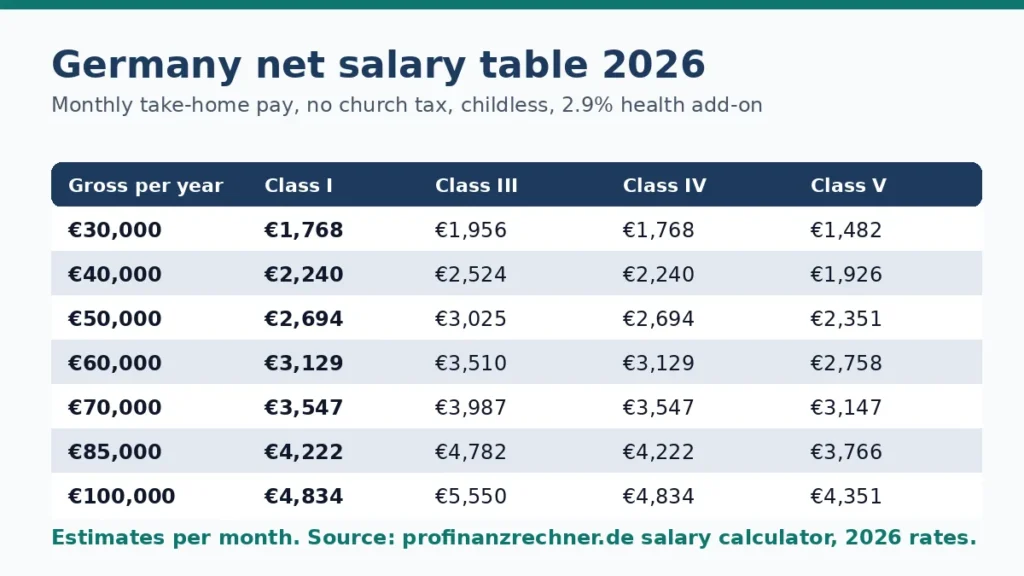
Net salary table 2026
Monthly take-home pay under these assumptions: no children, age 23 or older, statutory health insurance with the 2.9% average add-on, no church tax, no company pension (betriebliche Altersvorsorge) and no benefits in kind. Child allowances and private health insurance are not included. Columns III to V show the same gross salary under each tax class.
| Gross per year | Class I (single) | Class III (higher earner, married) | Class IV (married, similar incomes) | Class V (lower earner, married) |
| €30,000 | €1,768 | €1,956 | €1,768 | €1,482 |
| €40,000 | €2,240 | €2,524 | €2,240 | €1,926 |
| €50,000 | €2,694 | €3,025 | €2,694 | €2,351 |
| €60,000 | €3,129 | €3,510 | €3,129 | €2,758 |
| €70,000 | €3,547 | €3,987 | €3,547 | €3,147 |
| €85,000 | €4,222 | €4,782 | €4,222 | €3,766 |
| €100,000 | €4,834 | €5,550 | €4,834 | €4,351 |
Estimates. Your payslip may differ by a few euros. Class V and VI withholding is an approximation; your annual tax return sets the final amount.
With church tax (9%), class I at €54,066 falls from €2,873 to about €2,814 a month.
Tax classes I–VI explained
Which wage tax class applies to you in 2026 and who each wage tac class for.
Tax Class I
Tax Class II
Tax Class III
Tax Class IV
Tax Class V
Tax Class VI
Important: the tax class changes how much wage tax is withheld each month, not your final tax bill. Couples in III/V can pay back at year end if the withholding was too low.
Social contributions in detail
Long-term care insurance (Pflegeversicherung) by children
The 2026 care rate is 3.6%, split between employer and employee. Childless employees aged 23 or older pay a childless surcharge (Kinderlosenzuschlag) of 0.6 points. Each child from the second to the fifth reduces the employee share.
| Children | Total rate | Employee share |
| None | 4.2% | 2.4% |
| 1 | 3.6% | 1.8% |
| 2 | 3.35% | 1.55% |
| 3 | 3.1% | 1.3% |
| 4 | 2.85% | 1.05% |
| 5 or more | 2.6% | 0.8% |
Employees in Saxony pay an extra 0.5 points, because Saxony kept a public holiday when care insurance was introduced.
Health insurance and your add-on
The general health rate is 14.6%. Each statutory health insurer (Krankenkasse) also sets its own additional contribution (Zusatzbeitrag); the 2026 average is 2.9%. Together they make up the total contribution rate, the Kassensatz (17.5% on average). Your insurer’s add-on matters: one percentage point less saves you about half of it from your own pay, roughly €300 a year at a €60,000 salary.
Employees earning above the compulsory insurance threshold (Versicherungspflichtgrenze, also called the annual earnings threshold, Jahresarbeitsentgeltgrenze) can choose private health insurance (private Krankenversicherung, PKV) instead. The salary calculator Germany does not model private insurance yet.
Employer cost: what the salary costs the company
Your employer pays a share of your social insurance on top of your gross salary, roughly 21%. For a €36,000 gross salary, the employer share is about €7,614, so the total employment cost is about €43,614 a year (about €3,634 a month). This excludes the employer levies U1, U2 and U3 and statutory accident insurance, which differ by company.
Your take-home pay does not change because of these employer contributions. They are shown separately to reflect the full cost of employing you.
Is my salary good in Germany?
The salary calculator Germany gives three verdicts. Here is how each one works.
Market (Germany). The benchmarks come from the Destatis (Federal Statistical Office) Verdiensterhebung 2025, press release PD26_113 (April 2026). They cover full-time employees, gross per year, including special payments:
| Position | Gross per year | Net per month, class I |
| Bottom 10% | €33,828 | ≈ €1,951 |
| Bottom 30% | €44,215 | ≈ €2,434 |
| Median | €54,066 | ≈ €2,873 |
| Average (mean) | €64,441 | ≈ €3,316 |
| Top 10% | €100,719 | ≈ €4,862 |
Industry. Your gross salary as a share of the industry median. Below 90% is below average, 90–110% is in line, 110–150% is above the median, and over 150% is well above it. Destatis publishes these medians for four sectors:
Industry | Median gross per year |
|---|---|
Energy supply | €77,522 |
Finance and insurance | €76,594 |
Agriculture, forestry and fishing | €35,689 |
Accommodation and food service (hospitality) | €35,545 |
Public-sector pay (TVöD). If you work for the federal public sector, select your pay grade and step. The Germen salary calculator compares your monthly pay with the table valid from 1 May 2026, scaled to 39 hours. Within 1% is “at tariff”; more than 1% above or below is shown as a difference. A gap below the tariff is worth checking on your payslip. The salary calculator Germany covers the federal TVöD only, not TV-L or the municipal (VKA) agreement.
Pay also differs by region. In 2025, the median was €46,013 in eastern Germany (excluding Berlin) and €55,435 in western Germany.
Rent often matters more than net salary when comparing cities. To see how far a salary goes on a home loan, try the real estate financing calculator.
Net figures are estimates from the same engine as the table above.
What a raise is worth
Germany’s tax system has no cliffs: a raise is taxed only at the higher rate on the extra money, never on your existing salary. But the marginal tax rate (Grenzsteuersatz) on each extra euro is high, and that is the number to use in a salary negotiation (Gehaltsverhandlung).
At a €50,000 salary in tax class I, a €1,000 annual raise adds about €44 a month net. Roughly 47 cents of each extra euro goes to tax and contributions. The Germany salary calculator shows this figure for any raise you enter.
Your marginal rate also matters for pension savings. Deductible retirement contributions save tax at this marginal rate, not your average (effective) tax rate. To test other salaries, use the income tax calculator.
What changed in 2026
Parents on leave can estimate their benefit with the parental allowance calculator.
Church tax, Soli and where you live
Church tax
Church tax is 9% of wage tax in most states and 8% in Bavaria and Baden-Württemberg. Child allowances reduce its base. You can end it only by formally leaving the church. The church tax calculator shows the difference for your salary.
Solidarity surcharge
Solidarity surcharge applies only once your annual wage tax exceeds €20,350 (single). Most employees are below that line.
Income tax
Income tax is the same everywhere in Germany. Only church tax and the care rate in Saxony depend on your federal state.