Income Tax Calculator
Income Tax Calculator
As of: 2026, calculated according to § 32a EStG (basic tariff/splitting tariff). This calculation is for guidance only and does not replace professional tax advice. Progression clause, capital gains, and extraordinary income are not taken into account.
Our Income Tax Calculator shows you in seconds how much income tax, solidarity surcharge, and church tax apply to your taxable income, based on the current 2026 tax tariff (§ 32a EStG). Enter your taxable income, select your marital status, and get your tax liability, average tax rate, and marginal tax rate instantly.
The calculator works for employees, retirees, the self-employed, and freelancers alike, since income tax is calculated on taxable income using the same tariff for everyone, regardless of the type of income. You’ll find more free finance and tax calculators for Germany at Pro Finanzrechner.
What is Taxable Income?
Taxable income is not your gross or net salary. It’s the assessment basis the tax office applies the income tax tariff to, arrived at only after deducting:
You’ll usually find your taxable income on your most recent tax assessment notice.
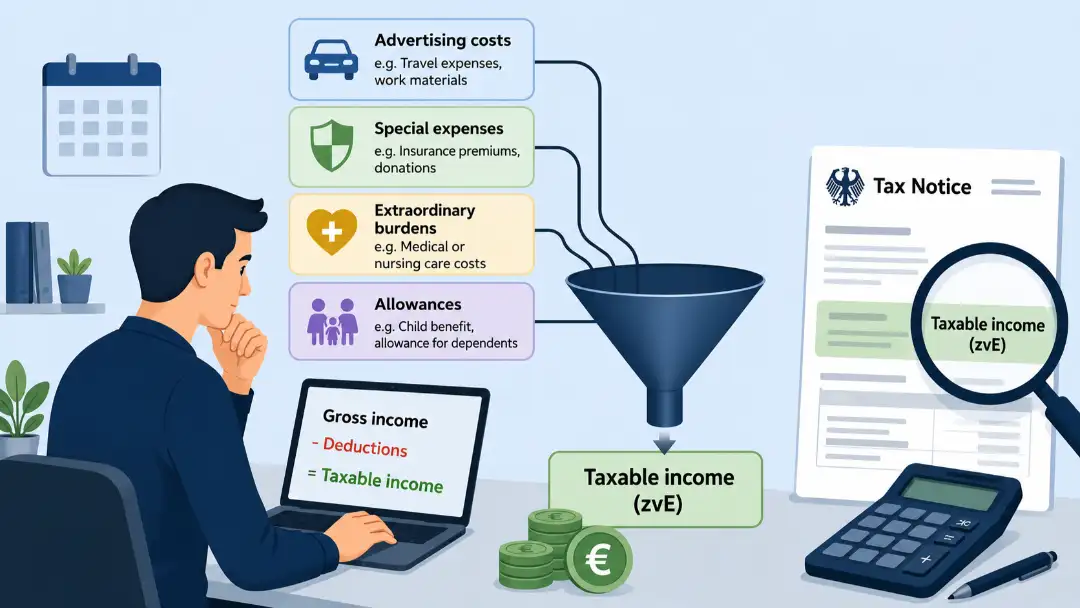
What reduces your taxable income?
Commuting allowance:
Employees who commute to work daily can claim a flat-rate allowance for the distance between home and their primary place of work as income-related expenses. This directly lowers taxable income and, with it, your tax liability.
Child allowance:
Parents receive an allowance of €3,414 per child (€6,828 for married couples filing jointly), plus an additional childcare allowance. The tax office automatically checks, as part of the so-called favorability test, whether the child allowance or the child benefit paid out is more advantageous for you.
How the 2026 income tax tariff works (§ 32a EStG)
Germany doesn’t use a simple bracket model with fixed percentages. Instead, the tariff is divided into five zones, with the tax rate rising continuously, not in jumps, within the two progression zones. Our Income Tax Calculator automatically applies the current income tax tariff.
Zone | Taxable income |
|---|---|
1 – Zero zone | up to €12,348 |
2 – Progression zone I | €12,349 – €17,799 |
3 – Progression zone II | €17,800 – €69,878 |
4 – Proportional zone | €69,879 – €277,825 |
5 – Top-rate zone | from €277,826 |
Important: a top tax rate of 42% doesn’t mean 42% of your entire income goes to the tax office. Each euro is only taxed within the zone it falls into, which is why your actual average tax rate is always lower than your marginal tax rate (the rate on the last euro earned).
Basic Tax-Free Allowance 2026
The basic tax-free allowance rises to €12,348 in 2026 (2025: €12,096) for single filers and €24,696 for jointly assessed married couples. No income tax is due up to this amount; it safeguards the tax-free subsistence minimum.
Worked Example
For a taxable income of €45,000 (single, no church tax), income tax comes to around €8,835, an average tax rate of about 19.6%. The marginal tax rate on the next euro earned, however, is already considerably higher at this point, since progression isn’t yet complete. Use the Income Tax Calculator to compare different income levels directly.
Income Tax for Married Couples:
Joint assessment and splitting
Married couples and registered civil partners can choose between individual and joint assessment. Our Income Tax Calculator takes the chosen assessment type into account and calculates the corresponding tax burden. Joint assessment applies the spousal splitting method (§ 32a para. 5 EStG):
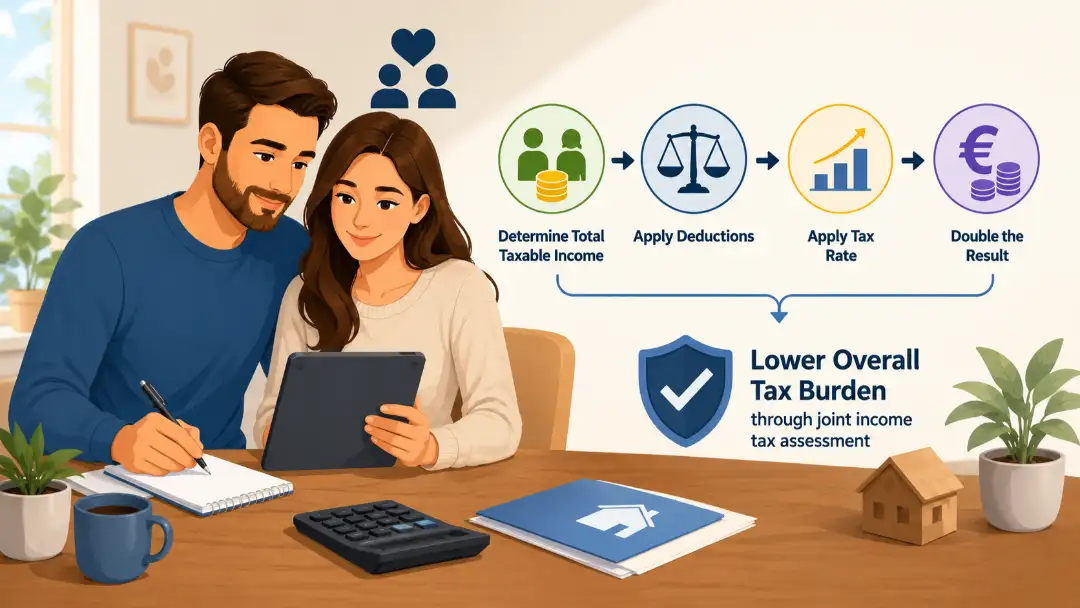
Since the tariff is progressive, this halving reduces the couple’s combined tax burden, and the effect is stronger the more the partners’ incomes differ. If both earn roughly the same, the benefit is small; with a large income gap, it can be substantial. Our calculator applies the splitting method automatically. If you select “joint assessment” above, simply enter the couple’s combined taxable income.
Income Tax for the Self-Employed and Freelancers
Unlike employees, whose tax is withheld monthly via wage tax, self-employed people and freelancers pay their income tax through quarterly advance payments to the tax office, due March 10, June 10, September 10, and December 10.
The basis here is also taxable income: revenue minus business expenses, pension contributions, and special expenses. If your profits drop during the year, you can file an informal request with the tax office to reduce your advance payments. Based on your estimated taxable income, our calculator shows you the realistic annual tax burden, and therefore the quarterly advance payment, you can expect.
Freelancers additionally pay no trade tax, unlike commercially active self-employed individuals and small business owners, who must pay trade tax on top of income tax.
Income tax on pensions
Pensions are also subject to income tax, though only proportionally, via the so-called taxable percentage, which depends on the year you first started drawing your pension. With our Income Tax Calculator, retirees can easily calculate their expected tax burden based on their taxable income. For pensions first drawn in 2026, the taxable percentage is already close to 100%. This covers:

If your total taxable income, including the taxable portion of your pension and any other income, is below the basic allowance of €12,348, no income tax is due. To calculate this, simply enter your taxable pension portion plus any other income as your taxable income in the calculator.
Solidarity surcharge (Soli) 2026
The solidarity surcharge was introduced in 1991 to help finance the rebuilding of eastern Germany and has not applied to around 90% of taxpayers since 2021. Anyone still subject to it pays 5.5% of their income tax, but only once a certain threshold is exceeded:
Below this threshold, no Soli is due. Above it, a tapering zone applies first, in which the surcharge rises gradually to the full 5.5% rate rather than becoming due in full immediately.
Church Tax
If you’re a member of a tax-collecting church or religious community, church tax is added on top of your income tax. In Germany this mainly affects Catholics and Protestants, and it funds church institutions, schools, and social services in the community:
Like the Soli, church tax is added on top of your already-calculated income tax, not applied directly to your taxable income. If you’re not registered as a church member, no church tax applies.
Progression clause: when replacement wage benefits raise your tax rate
Certain tax-free income, such as unemployment benefit, short-time work allowance, parental allowance, or sick pay, remains tax-free itself but raises your tax rate on your remaining taxable income. This is known as the progression clause (§ 32b EStG): the tax office calculates the rate as if these benefits were part of your taxable income, but applies it only to your actually taxable income. Anyone who received such replacement wage benefits during the year effectively pays somewhat more tax on their regular income as a result.
Tax refund: can I get income tax back?
Yes. Through your annual tax return, the tax office reconciles the tax you paid during the year (wage tax or advance payments) against the income tax actually calculated under § 32a EStG. If you paid more than what’s owed according to this calculator, for example because additional income-related expenses, special expenses, or extraordinary burdens further reduce your taxable income, you receive the difference back as a refund.
Conclusion – Income Tax Calculator
With our Income Tax Calculator, you can quickly and reliably calculate how much income tax, solidarity surcharge, and church tax apply to your taxable income in 2026, whether you’re an employee, retiree, self-employed, or a freelancer. The calculation follows the statutory tax tariff under § 32a EStG exactly, factors in spousal splitting on request, and shows you your average and marginal tax rate alongside your tax liability. This gives you a realistic basis for your financial planning, your tax return, or checking your quarterly advance payments. The Income Tax Calculator is intended for guidance only and does not replace a binding tax assessment or individual tax advice.