Church Tax Germany Calculator – Calculate Your Church Tax
Income
Personal & Residence
Deductions
This tool uses the 2025 income tax formulas (§32a EStG) and estimates Soli/Church tax. It's an estimation and not official tax advice.
If you live in Germany, earn an income, and belong to a religious community, the Church Tax Germany Calculator helps you determine your church tax quickly and accurately. Your church tax liability depends, among other things, on your income tax, your federal state, and your marital status. The Church Tax Germany Calculator factors in all relevant variables and gives you a precise result. You’ll find more finance calculators covering taxes and money matters in Germany on Profinanzrechner.
This article explains all the factors that affect your church tax, no matter how small the amount. You’ll learn who’s liable to pay, how the tax is calculated, and when it’s due. Special cases such as married couples and Germans living abroad are also covered, along with membership and the process of leaving the church.
What Is Church Tax in Germany?
If you live in Germany and belong to a particular religious community, that community has the right to collect church tax from you under the relevant state church law. This isn’t deducted directly from your taxable income.
Church tax is a type of surcharge tax, calculated as a percentage of your income tax. It’s either collected by the church communities themselves or administered by the tax office through the annual assessment and payroll deductions.
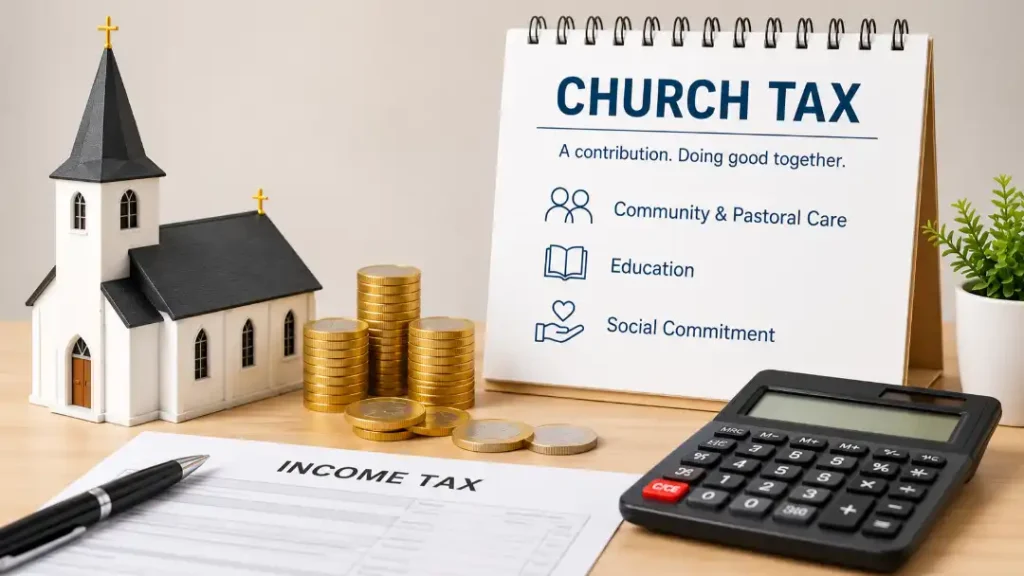
The tax revenue collected is then invested in various areas of social work for the community, such as pastoral care, preservation of cultural heritage, education, and more.
How High Is the Church Tax Rate in Germany?
The exact amount of your church tax depends on where you live.
Since church tax is calculated as a percentage of your income tax, fluctuations in your income tax such as allowances or deductions can raise or lower your church tax accordingly. That’s why our Church Tax Germany Calculator first calculates your income tax and then applies the 8–9% church tax rate to it.
Capping Church Tax for High Incomes
For very high incomes, church tax can be capped at a fixed percentage of taxable income — known as “Kappung.” The cap rate ranges from 2.75% to 4% of taxable income, depending on the federal state. In Berlin, Brandenburg, Bremen, Hamburg, Mecklenburg-Vorpommern, Lower Saxony, Saxony, Saxony-Anhalt, Schleswig-Holstein, and Thuringia, the cap is applied automatically. In Baden-Württemberg, Hesse, North Rhine-Westphalia, Rhineland-Palatinate, and Saarland, it must be requested from the relevant church tax office. Bavaria has no cap rule at all.
Example: With a taxable income of €200,000 and a cap rate of 3%, the maximum church tax is €6,000 per year, even if 9% of the income tax would work out to more.
Church Tax as a Deductible Special Expense
Church tax paid can be claimed as a special expense (Sonderausgabe) in your tax return, reducing your taxable income. As a result, the actual financial burden is usually lower than the nominal 8% or 9% rate.
Use the Church Tax Germany Calculator for Your Annual Tax Planning
The Church Tax Germany Calculator is one of the most valuable tools available, free to use as often as you like.
Before the year begins
You can use it at the start of the year to check how your place of residence and marital status affect your expected income.
At the end of the year
You can use the calculator at year-end to predict any potential back payments and set money aside for them.
After a major life change
Significant changes such as new investments, moving to a different federal state, leaving the church, a pay raise, or getting married can affect your income tax and, indirectly, your church tax.
Whatever point in the year you’re at, the Church Tax Germany Calculator helps you determine your church tax accurately and instantly.
When Is Church Tax Due in Germany?
The exact timing of your church tax payment depends on your type of employment. For example:
Employees
For salaried employees, church tax is deducted monthly from their pay together with income tax. The employer uses electronic wage tax data (ELStAM), which already contains information about church membership, and calculates the tax according to the applicable state rate.
Self-employed individuals or those with additional income
For self-employed people and those with side income, church tax is settled through quarterly advance payments and the annual income tax assessment (also called the annual income tax return). Church tax generally rises proportionally with the income tax rate applied at assessment. If the income tax rate falls, church tax is refunded accordingly.
Investment income
If church membership has already been established via the central church tax database, known as KiStAM, banks automatically withhold church tax on capital gains.
If church membership can’t be determined, your church tax is set as part of the annual assessment.
Which Religious Communities Must Pay Church Tax?
Below are the religious communities that most commonly collect church tax.

In some federal states, smaller religious communities also have the right to levy taxes. Religious communities that don’t collect taxes or don’t hold public-law status generally fall outside this system. Whether you count as a member for church tax purposes depends on church records and your local residents’ registration office.
Which Religious Communities Are Exempt from Church Tax?
Church tax can’t be levied by denominations and religions that don’t hold tax-collecting rights or public-law status. Many Muslim, Hindu, and Buddhist associations, which vary in their local structure, fall into this category. If you don’t belong to a church that collects church tax, no tax deductions are made from your income. The Church Tax Germany Calculator should therefore show €0 for this item.
The Effect of Marriage on Church Tax in Germany
Getting married in Germany affects church tax in two ways:
Tax splitting (Ehegattensplitting)
When a married couple files a joint income tax return, their combined income is split. The resulting tax assessment basis is used to calculate church tax. Since church tax depends on income tax, changes resulting from this splitting also affect the amount of church tax owed.
Couples of different religions
For couples of different religions, there are two distinct cases: both religions collect church tax, or only one spouse belongs to a religion that does.
Both spouses are members
If both spouses are members of tax-collecting communities (even different ones), each spouse’s church tax is calculated in proportion to their share of the taxable income in the joint assessment.
Only one spouse is a member
If only one spouse is a member, many federal states levy a special church tax called “Kirchgeld” if the non-member spouse gains a significant income advantage from the arrangement. This is a flat amount based on the couple’s standard of living and combined income. Its purpose is to prevent tax avoidance where the higher-earning partner leaves the church while the lower-earning partner remains a member. The applicable tax table for your federal state can be found in correspondence from your tax office or church community.
The Church Tax Germany Calculator is designed with fields for entering your marital status. You can adjust the calculator to match your situation, for example whether you’re assessed jointly or separately.
How Much Do Expats Have to Pay?
Foreign nationals are treated the same in Germany if they’re subject to tax there and belong to a religious community that collects church tax. This means they’re also required to pay this tax. What matters here isn’t nationality, but religious affiliation.
Below are some of the most common scenarios an expat in Germany may encounter.

Registered with the church (Anmeldung)
As part of your registration, you’re recognized as a church member if you register as “Protestant” or “Roman Catholic,” and are therefore liable to pay. During standard registration checks, you may also need to present documentation such as baptism or membership certificates.
Registered as “no religion” (ohne Konfession)
Anyone who doesn’t belong to a religion doesn’t have to pay church tax. However, you should be careful not to provide false information by claiming no religious affiliation when that isn’t accurate.
For foreigners living abroad, non-residents
If you live in Germany as a non-resident, you have only limited tax obligations, and paying church tax isn’t one of them unless specific wage tax withholding rules apply to German-source income in connection with recognized membership.
In short: a German living abroad is subject to German income tax if they’re a resident there and belong to a tax-collecting religious community. Our Church Tax Germany Calculator offers a fast, precise solution to this and can also be used by Germans living abroad.
How Can Church Tax Be Avoided?
Legally speaking, there are only a few cases in which a person doesn’t have to pay church tax.
Fundamentally, aside from these three conditions, there are no other exemptions from church tax. As long as you’re a church member and have taxable income, you’re required to pay church tax.
How Do You Leave the Church?
Leaving the church is a formal legal act, carried out at the citizens’ registration office, local court, or registry office, depending on the federal state. Generally, the following steps are required:
Church tax generally stops being due from the month after your declaration. Once the change has been communicated by the authorities to the ELStAM/KiStAM systems, payroll administration and banks are updated accordingly. In the annual tax assessment, church tax is calculated proportionally for the months you were still a church member. You can use our Church Tax Germany Calculator to determine the months for which church tax will be calculated in your annual assessment.
How Much Is Church Tax for Students, Retirees, and Low-Income Households?
Across all these scenarios, one thing stays constant: if income tax is zero, church tax is zero too.
Conclusion – Church Tax Germany Calculator
At first glance, church tax in Germany looks simple: it’s 8% or 9% of your income tax. In practice, though, it’s a bit more complex and depends on several factors, such as your church affiliation, tax deductions, income tax, and marital status. The Church Tax Germany Calculator and the explanations in this article help you better understand church tax. With the calculator, this often-confusing levy becomes more transparent and easier to follow.