Vehicle Tax Calculator – Auto & Car Tax Calculator Germany
Calculate your annual German car tax (Kfz-Steuer) according to the Motor Vehicle Tax Act (KraftStG).
Vehicle Type
Navigating the German vehicle tax system can be quite daunting, especially for expats unfamiliar with local laws or for new car owners. That’s why Pro Finanzrechner offers a vehicle tax calculator to help you calculate your vehicle tax. You can find other helpful financial calculators on the Profinanzrechner.
Regardless of the type of vehicle you drive diesel, gasoline, or electric you are likely subject to vehicle tax, specifically the German motor vehicle tax. The amount of tax payable annually depends on various factors, such as the vehicle’s engine size, its CO₂ emissions, and its fuel type.
Why Car Tax Calculator is Important?
To make your process simpler and instantaneous our car tax calculator Germany helps you calculate how much vehicle tax you have to pay accurately.
The following guide provides you with a proper breakdown of everything you need to know about vehicle tax in Germany. It also covers various aspect such as how to calculate tax, due dates and exemptions.
The purpose of this article is to provide you with a complete analysis of how the German Tax system works, why it is crucial to file tax return, and instructions on how to use our tax refund calculator Germany to make your process easier and more efficient.
The Point of Applying The Road Tax in Germany
The German government pursues two main goals with the introduction of the vehicle tax. The first goal is to generate revenue for the improvement of roads and infrastructure; the second goal is to create a better environment. For this reason, the vehicle tax calculator is so important for Germans.
The tax structure is placed in a way that it penalizes those vehicles that produce higher amounts of CO₂ and encourages the general population to chose for themselves vehicles that are better for the environment.
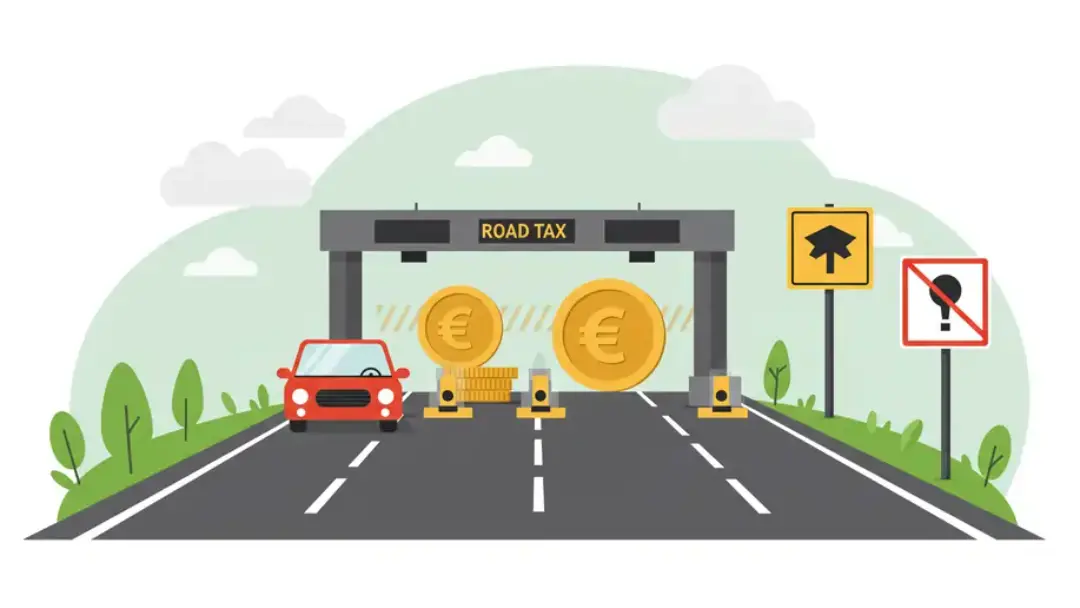
In short, this tax contributes to the sustainability of the government’s goals and the environmental and transport infrastructure, while simultaneously ensuring that vehicle owners make a fair contribution to road maintenance and the associated public expenditures. The legal basis is the Motor Vehicle Tax Act (KraftStG). In particular, Sections 1 (Taxable Object), 2 (Tax Debtor), and 8 and 9 (Tax Rates and Tax Calculation) are relevant.
Which Vehicles Get Unlimited Tax Exemptions
Some vehicles due to their special nature and their role in public service, are exempted permanently from paying vehicle tax. The vehicles that are exempted from paying vehicle tax are:
The use of such vehicle and their exemption from motor tax is justified on the basis that these vehicles are crucial for the community and have limited impact on the environment.
Which Vehicles Get Temporary Tax Exemption
In Germany, if certain motor vehicles meet some specific requirements, they can be temporarily exempted from paying motor vehicle tax. These includes the following:
These vehicles are granted exemption only for a limited period and will have to pay standard tax rates once the period is over.
How to Apply for Tax Exemption
To benefit from any tax exemption, vehicle owners must formally submit their application to the main customs office (Hauptzollamt).
The application process requires the vehicle owners to submit supporting documents alongside the application, which are registration papers, proof of such as a disability ID or a farming license, and in certain cases a written verification from the public authorities is also required.

Your approval wholly depends upon whether or not you fulfil the eligibility criteria. If you are approved for tax exemption you will receive a certificate that confirms your tax-exempt status.
How to get a Refund on Motor Tax
In Germany, the vehicle tax is paid in advance for one whole year. In case the vehicle is sold, deregistered, or exported mid-year. The unused portion of the tax is reimbursed proportionally, and here Pro Finanzrechner’s vehicle tax calculator helps you a lot to save money. This reimbursement process involves the following steps:
The refund depends upon the regional processing times and usually takes up to 2 to 4 weeks.
How can the Vehicle Tax be Reduced?
Vehicle owners can receive a partial reduction in their motor vehicle tax in certain cases such as:
The rate of motor vehicle tax reduction directly depends upon the vehicle type and its usage. These reductions are granted on the basis of proper documentation. Before filing, calculate vehicle tax and prepare your documents accordingly.
Duration of Motor Vehicle Tax
Motor vehicle tax starts being applicable from the day of registration and lasts until the vehicle is deregistered. Your obligation to give tax ends once the deregistration is confirmed by the local licensing authority. Deregistration occurs if you change car ownership or move to another EU country. The tax duration of motor vehicle tax is annual; however, it can be changed to short-term registrations such as seasonal vehicles (motorhomes) or temporary plates.
Motor Vehicle Tax Due Date
The tax is paid once a year on the same day as the initial registration. A payment notification is sent by the Federal Customs Authority, and if a SEPA id mandared in its place, the amount of motor vehicle tax is automatically deducted. If a car owner fails to pay on time, he will get a late fine and in extreme cases, his car registration rights could get suspended.
In order to avoid missing a deadline, many vehicle owners use a car tax calculator in Germany. It not only provides its users with an accurate amount that is to be paid but also gives reminders for due dates.
Determination of the Tax Rate
The tax rate for motor vehicles in Germany is determined by a combination of:

An example for a gasoline-powered car first registered from 2021 onwards, with a 1,600 cm³ engine capacity and 120 g/km CO₂ emissions:
Base amount based on engine capacity: 16 × €2.00 = €32.00
CO₂ component: 25 g above the exemption limit of 95 g/km, tiered according to the current CO₂ table → €50.00
Total tax per year = €82.00
For a diesel vehicle with the same specifications, a higher basic amount of €9.50 instead of €2.00 per 100 cm³ applies, as diesel vehicles are subject to higher taxes.
CO₂ tax after initial registration from 2021 (tiered):
CO₂ emissions | Tax per g CO₂/km |
|---|---|
over 95 to 115 g/km | €2.00 |
over 115 to 135 g/km | €2.20 |
over 135 to 155 g/km | €2.50 |
over 155 to 175 g/km | €2.90 |
over 175 to 195 g/km | €3.40 |
over 195 g/km | €4.00 |
For vehicles first registered between July 2009 and the end of 2020, a uniform rate of €2.00 per gram above the exemption limit applies, regardless of the CO₂ emissions. For vehicles first registered before July 2009, the tax is based on the emissions standard (Euro standard) instead of CO₂ emissions.
Supplement: Euro Standard Table
Directly after the already inserted CO₂ table, as a supplement for vehicles first registered before July 2009:
Vehicle tax according to emissions class (first registration before July 2009), per 100 cm³ of engine displacement:
Euro standard | Petrol | Diesel |
|---|---|---|
Euro 3 and better (up to 2.5 t) | €6.75 | €15.44 |
Euro 2 | €7.36 | €16.05 |
Euro 1 | €15.13 | €27.35 |
Euro 0 (without ozone driving ban) | €21.07 | €33.29 |
Euro 0 (remaining) | €25.36 | €37.58 |
The emissions class is stated in the vehicle registration certificate, Part I, or in the old vehicle registration document. The date of first registration is always decisive: vehicles registered before July 1, 2009, are taxed according to this model, all later vehicles according to the engine displacement plus CO₂ formula.
The Amount of Motor Vehicle Tax is Influenced by
The following are the variables that have an impact on the amount of motor vehicle tax you have to pay:
You will be free from the hassle of having to figure out which variables to factor in while paying your motor car tax if you use the auto tax calculator Germany.
Vehicle Taxes for Electric Cars in Germany
Electric vehicles receive numerous tax benefits as part of Germany’s efforts to reduce CO₂ emissions. Pure electric vehicles that are first registered or fully converted to electric drive by December 31, 2030, are exempt from vehicle tax until the end of 2035. An electric car registered at the beginning of 2026 thus remains tax-free for almost ten years. The vehicle tax exemption remains in effect upon a change of ownership, but only until 2035 at the latest. After the tax exemption period expires, a reduced tax rate will be levied, the amount of which depends on political decisions.
This, however is not the case for Plug-in hybrids, as they are not always fully exempt from paying motor vehicle tax. The rate of their taxation depends wholly upon their battery range and CO₂ emissions. Even though they are not zero-emission vehicle but, their taxation rate is lower than a normal car.
For all EV owners, the auto tax calculator Germany is tailored for electric vehicles as well and can accurately reflect any benefits, discounts, or exemption periods.
Calculate the Amount of Motor Vehicle Tax using the car tax calculator Germany
Due to continuously changing policies and environmental surcharges, calculating your car tax manually can be a hectic and time-consuming process. You are also more likely to make mistakes. Hence, using the car tax calculator Germany becomes the need of the hour.
You only have to input the following key vehicle data:
And within a few moments, you will get a detailed breakdown of your annual tax and it will also include any exemptions or surchargers that might apply.
Conclusion
Understanding the vehicle tax system can seem quite difficult, but it becomes easier with the right tools for calculating vehicle tax. The right tool is the Pro Finance Calculator, a vehicle tax calculator for Germany that helps you make smarter financial decisions.