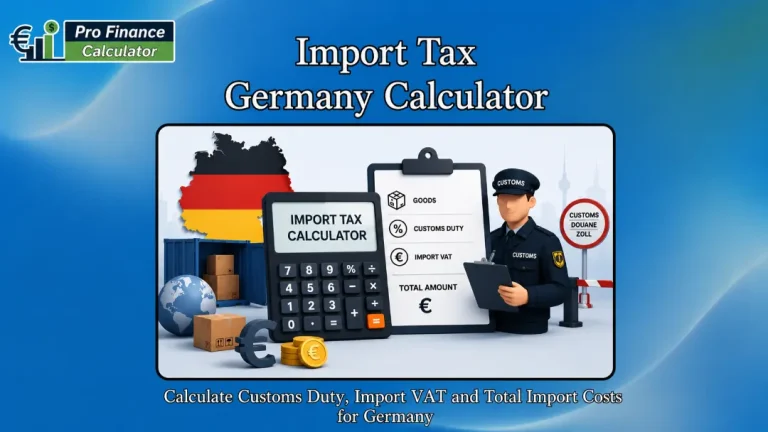
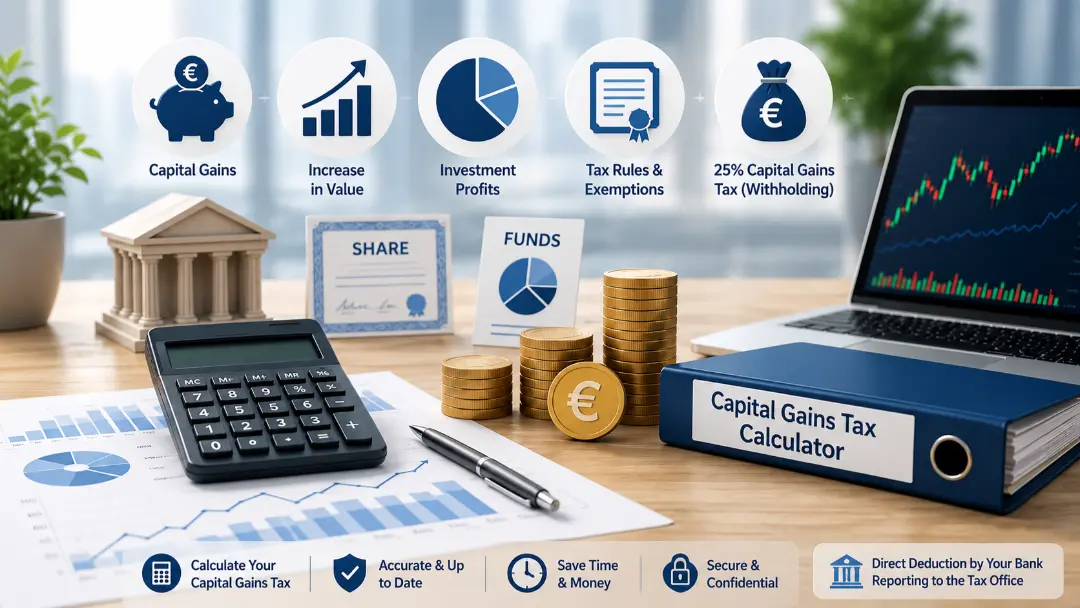
Capital Gains Tax Calculator – Calculate Withholding Tax on Investment Income
Enter Capital Gains
Personal Situation
In Germany, you pay capital gains tax, commonly known as the withholding tax (Abgeltungssteuer), on profits from stocks, ETFs, interest, and dividends. The flat tax rate is 25%, plus the solidarity surcharge and, depending on religious affiliation, church tax. With the Capital Gains Tax Calculator from Pro Finanzrechner, you can find out in seconds how much tax applies to your investment income and how much net profit you’re left with, either starting from your gross profit or working backward from a desired net amount.
Understanding Capital Gains Tax in Germany
Capital gains tax, also known as the withholding tax, has been the standard form of taxation for private investment income in Germany since 2009. It applies to profits from securities, interest, dividends, and fund units. The tax rate is a flat 25%, regardless of your personal income tax rate and regardless of how long you’ve held the investment.
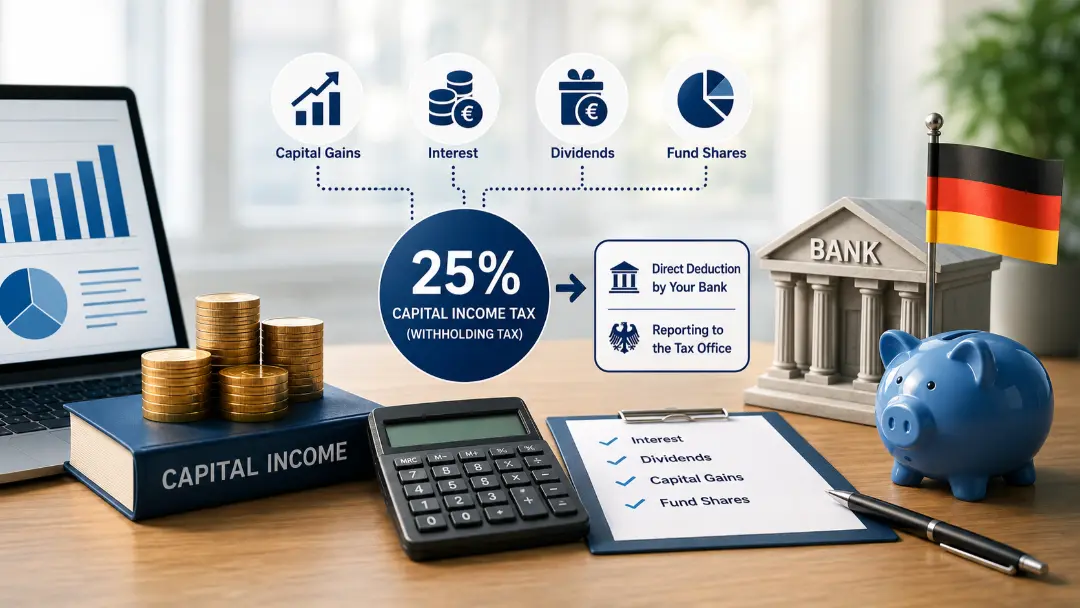
Important: Unlike real estate or cryptocurrencies, holding period doesn’t affect the tax rate for stocks, ETFs, and interest. The tax is withheld directly by your bank and paid to the tax office, so a tax return generally isn’t required.
Capital Gains Tax vs. Withholding Tax:
What’s the Difference?
The terms are mostly used interchangeably today, but there’s a historical distinction. Until 2008, investment income was taxed at your personal income tax rate, with different rates depending on the type of income (20% on dividends, 30% withholding tax on interest). Since January 1, 2009, these rules have been consolidated into a flat 25% withholding tax. Strictly speaking, capital gains tax is the predecessor of today’s withholding tax, but in everyday use both terms mean the same thing.
What Falls Under Capital Gains Tax?
The withholding tax applies to:
For stocks, ETFs, and bonds, the tax applies regardless of holding period. The flat rate is 25%, plus solidarity surcharge and church tax where applicable.
Cryptocurrencies Are Not Subject to Capital Gains Tax
Cryptocurrencies like Bitcoin or Ethereum aren’t subject to the withholding tax. Instead, they’re treated as private disposal transactions under Section 23 of the Income Tax Act (EStG). After a holding period of more than one year, profits are tax-free for private individuals. If sold sooner, profits are taxed at your personal income tax rate (with a tax-free allowance of €1,000 per year). For an exact calculation, it’s best to use a separate crypto tax calculator.
Real Estate Follows Different Rules
If a property is sold within ten years of purchase, the profit may be taxable (at the progressive income tax rate, not the flat 25% withholding tax). After a ten-year holding period, or if the property was used as your own home for at least two years, the sale is tax-free.
Saver’s Tax-Free Allowance 2026
Investment income remains tax-free up to a certain amount – the saver’s allowance (Sparerpauschbetrag). This remains unchanged in 2026 at:
For your bank to apply this allowance, you need to set up an exemption order (Freistellungsauftrag). Without one, the bank withholds tax from the first euro — this can only be reclaimed via your tax return (Anlage KAP).
Partial Exemption for Funds & ETFs
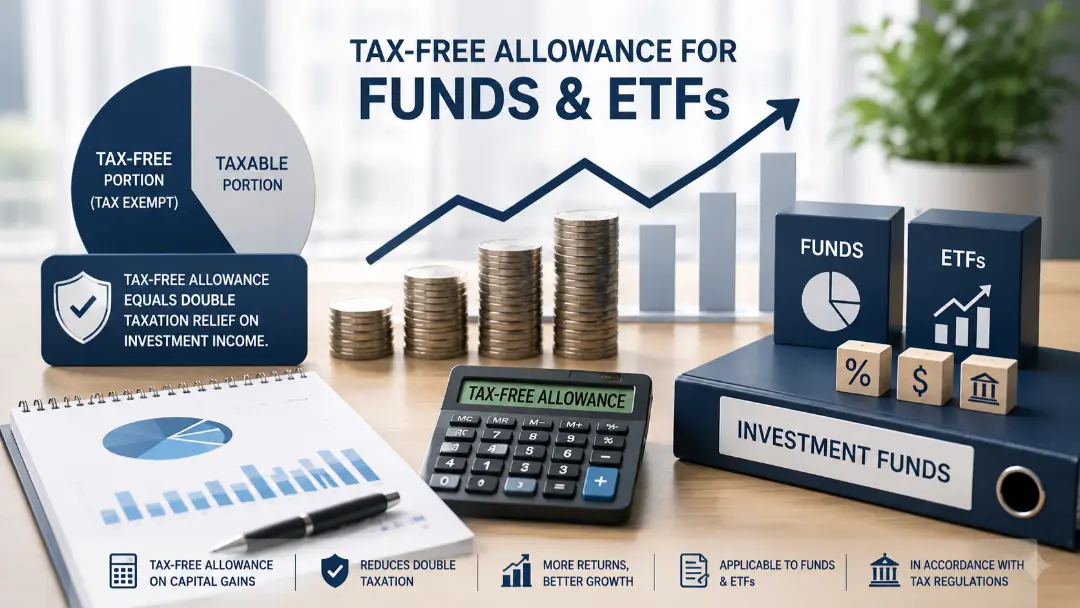
In addition to the saver’s allowance, a partial exemption applies to investment funds: a set percentage of returns is automatically tax-free, to offset double taxation at both the fund and investor level.
Fund Type | Partial Exemption |
|---|---|
Equity funds (min. 51% stocks) | 30% |
Mixed funds (min. 25% stocks) | 15% |
Open real estate funds | 60% (80% for foreign-focused) |
Other funds / bond ETFs | 0% |
Example: For a €1,000 ETF profit with a 30% partial exemption, only €700 is taxable.
Worked Example: How Your Capital Gains Tax Is Calculated
An example makes the calculation clearer:
Item | Amount |
|---|---|
Gross investment income | €5,000 |
Minus saver’s allowance | − €1,000 |
Taxable amount | €4,000 |
Withholding tax (25%) | €1,000 |
Solidarity surcharge (5.5% of tax) | €55 |
Total tax | €1,055 |
Net profit | €3,945 |
In this example, the effective tax rate is 21.1% of the gross profit – lower than the often-cited 26.375%, because the saver’s allowance makes part of the income tax-free from the outset. With church tax, the total burden increases by a further 8–9% of the withholding tax.
Reverse Calculation: From Net to Gross Amount
If you already know the net profit you want to achieve after tax, you can use the calculator in reverse. Simply select “investment income after tax.” The calculator will then determine the gross profit needed to reach that amount.
Favorability Check (Günstigerprüfung)
If your personal marginal tax rate is below 25%, you can apply for the favorability check (Section 32d (6) EStG) to have your investment income taxed at your lower personal rate instead. This is generally worthwhile for taxable income below roughly €62,000 (single filers). You apply for this via Anlage KAP in your tax return.
Offsetting Losses
Losses from investments can be offset against profits:
Foreign Withholding Tax
Foreign dividends often already have withholding tax deducted abroad:
Up to 15% of foreign withholding tax is generally credited against the German withholding tax.
In the Capital Gains Tax Calculator, you can enter the tax withheld abroad directly as a creditable amount, and the calculator automatically deducts it from your German withholding tax.
Conclusion – Capital Gains Tax Calculator
Capital gains tax on stocks, ETFs, and interest follows clear rules: 25% withholding tax, solidarity surcharge, and church tax where applicable, minus the saver’s allowance and partial exemption. Despite the clear legal basis, the practical calculation quickly becomes confusing due to several interlocking allowances and surcharges.
The Capital Gains Tax Calculator handles this calculation for you, including the saver’s allowance, partial exemption, church tax, and loss offsetting — showing transparently how much net profit you actually keep.