Parental Allowance Calculator Germany – Calculate Elterngeld
Income
Family Details
Employment & Allowance
This calculation is a non-binding estimate, particularly for the Partnership Bonus. The actual amount will be determined by your responsible parental allowance office.
Financial stability, especially in the first months after a child’s birth, is a key concern for many couples planning a family in Germany. The German government offers young parents financial support through Elterngeld (parental allowance), enabling them to raise their newborn without financial hardship.
For new parents, working out the parental allowance they’re entitled to can be tedious and complicated. That’s exactly why we built the Parental Allowance Calculator Germany. This tool factors in various aspects such as family situation, current income, and working hours, giving you a precise estimate. You’ll find more finance calculators covering family and money matters on Profinanzrechner.
This article explains in detail how parental allowance works, the different types available, the factors that affect how much you receive, and how to calculate it using the calculator. By the end of this article, you’ll be able to use the parental allowance calculator correctly to make more informed financial decisions.
What Is Parental Allowance in Germany?
In Germany, Elterngeld is a state benefit designed to replace part of a parent’s income after their child is born. It’s meant to ease the transition into family life by allowing parents to fully step away from work or reduce their working hours to care for their newborn, without suffering a full loss of income.
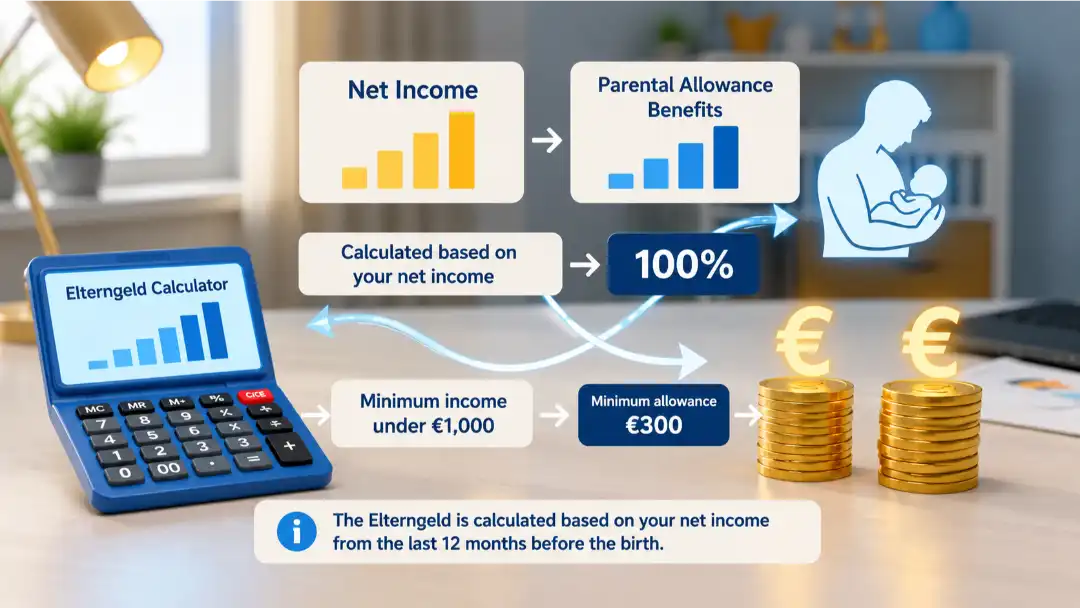
The amount of support depends on the parents’ income before the child’s birth and ranges from €300 to €1,800 per month. Parents who were unemployed before their child’s birth also receive at least €300.

Why Does the Parental Allowance Calculator Germany Matter?
Working out the parental support you’re entitled to isn’t a simple task, especially since many factors can influence the final amount.
Factors such as whether the employer grants parental leave, the number of children already in the family, income before the child’s birth, and employment status after the birth all play a role.
Our Parental Allowance Calculator Germany simplifies this complex process and provides an accurate estimate of the monthly benefit for parents. Without such a user-friendly and effective calculator, parents would likely struggle to realistically plan their budget for the months following the birth.
Factors That Influence the Amount of Parental Allowance in Germany
To understand what level of support a new parent is entitled to, the following variables need to be taken into account, as they affect the final calculation.
1. Income before the birth
The parents’ average net income in the twelve months before the child’s birth is one of the most important factors in calculating the allowance amount. This typically comes to 65% to 67% of previous net income.
Parents with a net income below €1,240 receive up to 100% of their income as parental allowance, while parents with higher incomes receive 65% to 67% of their income as the benefit.
Example: If a parent earns €2,000 net per month before their child’s birth, the parental allowance typically comes to around €1,300 to €1,340 per month.
2. Income limit for eligibility
Since April 1, 2025, a uniform income limit applies: anyone with taxable income over €175,000 in the calendar year before the birth has no entitlement to parental allowance, regardless of whether they’re a single parent or a married couple filing jointly. What matters is solely the taxable income, not gross or net income.
3. Type of employment
Different rules apply to different types of employment, so stating your income sources is essential. This helps the government determine whether the parent is:
For the self-employed, the average taxable income from the previous year is used.
4. Number of children
An increase in parental allowance is granted in the form of a sibling bonus. This bonus is intended for families who already have children. Such families receive an additional 10% of their parental allowance. For Basiselterngeld, the minimum bonus is €75; for ElterngeldPlus, it’s €37.50. The sibling bonus is granted if the family meets one of the following two conditions:
5. Multiple births
For Basiselterngeld, the amount increases by €300 per additional child from a multiple birth; for ElterngeldPlus, by €150. For twins, for example, this means +€300 under Basiselterngeld or +€150 under ElterngeldPlus.
6. Type of parental support
Germany offers different types of parental allowance, with different amounts and payment durations.
Basiselterngeld (basic parental allowance)

ElterngeldPlus
Partnerschaftsbonus (partnership bonus)
The Parental Allowance Calculator Germany includes fields where you can enter the type of parental allowance you’ve chosen. The payment structure changes depending on the type selected.
7. Working hours after the birth
Parents in Germany can still receive parental allowance even while working part-time, as long as it doesn’t exceed 32 hours per week. However, the parental allowance is reduced due to this continued employment.
The parental allowance calculator Germany factors in your expected income after the child’s birth and adjusts the estimated allowance amount accordingly.
8. Parental allowance for low-income families
Parental allowance in Germany is more generous for low-income households. The replacement rate increases by 0.1% for every euro that net income falls below €1,240. This means low-income parents can have up to 100% of their income replaced.
9. Regional differences and taxation
Although parental allowance itself isn’t taxable, it is subject to the progression clause (Progressionsvorbehalt). This means it can indirectly affect the household’s net income by raising the tax rate applied to the rest of their income.
The parental allowance calculator Germany accounts for this factor by clearly showing the difference between the gross and net amounts.
How the Parental Allowance Calculator Germany Works
To determine the exact amount of your parental allowance, the calculator needs the following information:
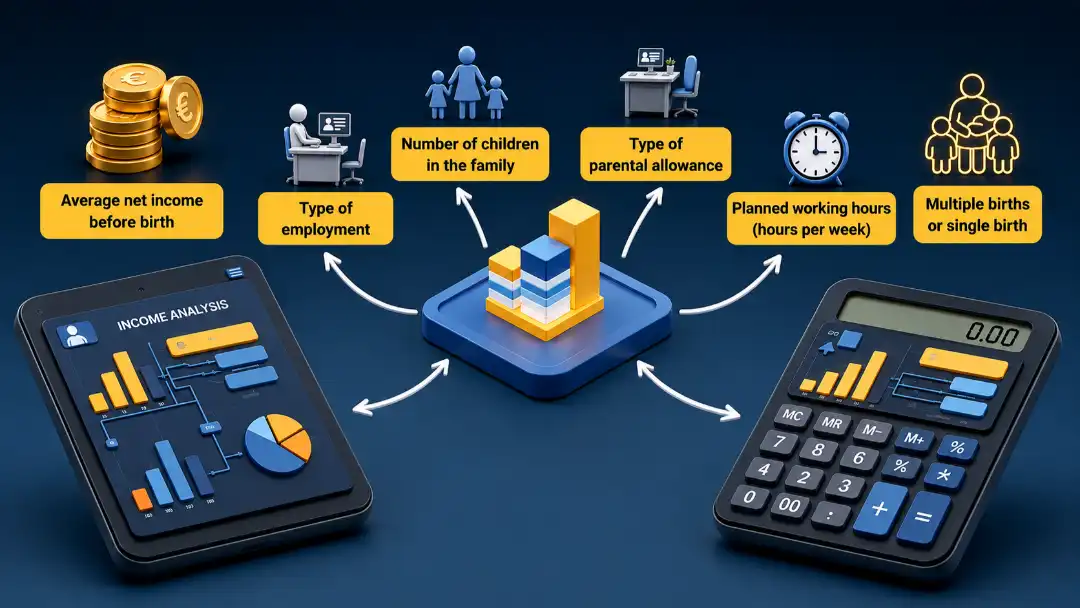
Once you’ve entered this information into the Parental Allowance Calculator Germany, you’ll get the duration of your payments along with an accurate estimate of the amount.
What Are the Benefits of Using the Parental Allowance Calculator Germany?
Tips for Parents Using the Calculator
Conclusion
For families with a young child, parental allowance is an important source of financial support. However, determining the exact amount is complex, since numerous factors need to be taken into account. These include income before the birth, multiple births, the number of children already in the family, the type of parental allowance, and employment status.
The Parental Allowance Calculator Germany empowers parents to make informed financial decisions by giving them a reliable, accurate calculation of their parental allowance. Families can make the most of their money by understanding the rules, benefits, and options available to them.
FAQs – Parental Allowance Calculator Germany
Similar Posts
Vehicle Tax Calculator
Vehicle Tax Calculator – Auto & Car Tax Calculator Germany Navigating the German vehicle tax…
Car Loan Calculator
Car Loan Calculator Financing a car in Germany involves a range of factors: interest rate,…
Capital Gains Tax Calculator
Capital Gains Tax Calculator – Calculate Withholding Tax on Investment Income In Germany, you pay…
Import Tax Germany Calculator
Import Tax Germany Calculator Thanks to its strong economy and central role in international trade,…
Crypto Tax Calculator
Crypto Tax Calculator Germany – Calculate Tax on Bitcoin & Other Cryptocurrencies Germany has recently…