
Import Tax Germany Calculator
Customs Calculator
Thanks to its strong economy and central role in international trade, Germany is a global hub for goods and imports. Whether you’re a business importing goods in bulk or an individual buying products from outside the EU, it pays to get familiar with Germany’s import tax system.
Once you understand the rules around duties and taxes in Germany, you can keep costs under control, avoid delays, and stay compliant with German law. An Import Tax Germany Calculator is one of the most effective ways to prepare for these obligations. You’ll find more handy finance calculators at Pro Finanzrechner.
Why does Germany charge import duties?
There are several reasons Germany charges import duties. First, they help fund public services like infrastructure. Second, they create a level playing field for domestic manufacturers. Third, they help ensure imported goods are taxed the same way as domestic ones at retail, through taxes such as VAT.
To navigate the German tax system with confidence, you can use the Import Tax Germany Calculator, which helps you predict the full cost breakdown of bringing a foreign product into Germany.
Components of import tax in Germany
Import tax in Germany is made up of several components, including customs duty, import VAT, and excise duty.
Customs duty
Duties apply as soon as goods enter the European Union. Customs duty is calculated based on the customs value, made up of the transaction price, insurance costs, and additional shipping costs. Duty rates depend mainly on how the goods are classified, which is defined by the Harmonized System (HS) code.

Example:
With the Import Tax Germany Calculator’s built-in HS code lookup, you can now work out exactly which rate applies to which type of goods.
VAT
VAT is charged in Germany on both imported and domestic goods. When importing products from non-EU countries, VAT is calculated on:
Example: a product worth €1,000 is subject to 10% duty and 19% VAT. The duty comes to €100, and VAT is calculated on €1,100, coming to €209. Total cost: €1,309.
Excise duty
Excise duty is charged based on quantity rather than value, and only applies to specific products such as:
The Import Tax Germany Calculator is a simple tool for working out these more complex, detailed product-specific calculations when importing items in these categories.
How an Import Tax Germany Calculator helps you estimate costs
For businesses and individuals unfamiliar with the customs system, calculating import duties can get complicated, especially when several duties apply at once. This is where an Import Tax Germany Calculator proves invaluable.
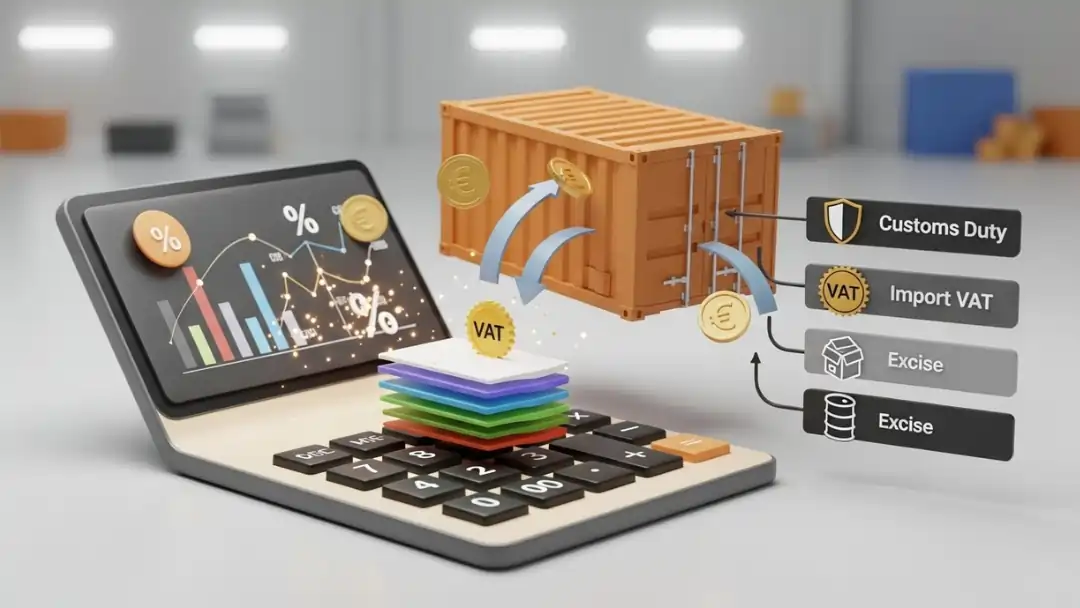
What it does
The tool factors in the following variables to give you an accurate estimate of your total import costs:
Once you’ve entered all the relevant information, it gives you a realistic, detailed breakdown of every cost involved. With this Import Tax Germany Calculator, importers can make informed business decisions and avoid unexpected costs.
When are import taxes due?
Import duties become due in Germany as soon as goods arrive in the country. Customs typically holds the goods until the required documents are submitted and all taxes are paid. Customs will notify importers of the amount due and the payment deadline.
If payments aren’t made on time, your shipment can be delayed, returned, or even seized. That’s why it makes sense to calculate all expected duties and charges in advance with our Import Tax Germany Calculator. This lets you better estimate your likely import costs and avoid unexpected charges or delays when bringing goods into Germany.
Common scenarios where import duties apply
Here are some common scenarios where import duties come into play:
The Import Tax Germany Calculator is a multi-purpose tool you can use to get financial clarity in any of these scenarios.
Which goods are exempt from import duty?
Under EU rules, certain types of imports into Germany are duty-free under specific circumstances.
Low-value goods
As of July 1, 2026, the previous duty exemption for shipments under €150 no longer applies. Instead, a flat duty of €3 is charged per product category within the shipment, on top of import VAT, which continues to apply from the very first euro as before.
Gifts
Private gift shipments sent from one individual to another, with no payment involved, are exempt from duty and import VAT up to €45. Between €45 and €700, a flat rate of 17.5% of the customs value can optionally be applied, covering both duty and import VAT together. Above €700, standard customs clearance applies.
Returned EU goods
If you’re sending back items that were previously exported from the European Union, you may be entitled to an exemption.
Moving personal belongings
If you’ve permanently relocated to Germany from another country and want to bring in your personal belongings, this is usually possible tax-free, subject to certain conditions and required documentation.
These exemptions only apply if you meet the requirements, and even then, restrictions may still apply. Before assuming your goods are tax-free, check the official German import tax guidelines or consult an Import Tax Germany Calculator to be sure.
Documentation required for customs clearance
Proper documentation is essential for customs clearance when importing goods into Germany. You’ll typically need:

Errors or missing documents can lead to delays or fines. Use the Import Tax Germany Calculator alongside your documentation to keep your figures consistent.
Tax considerations for businesses
Businesses that keep proper records and are VAT-registered when importing goods into Germany can reclaim import VAT through input tax deduction. To reclaim VAT, you’ll need:
The Import Tax Germany Calculator helps business owners work out whether their import costs still leave room for healthy resale margins and pricing.
Mistakes to avoid when estimating import tax
Tips for a smoother import process
Follow these steps to make sure your imports arrive without penalties or delays:
Conclusion
The Import Tax Germany Calculator isn’t just a handy tool, it’s an essential part of planning for any importer. It follows German customs regulations and helps you avoid unexpected costs at the border.
Use the Import Tax Germany Calculator before you ship your goods. It’s a small step that can save you time, money, and stress.