VAT Calculator Germany – Calculate Gross, Net and VAT
Add VAT
Remove VAT
This comprehensive guide explains value-added tax (VAT) and how it works in Germany. We break down the various factors that affect VAT and illustrate the calculation with practical examples. With our VAT Calculator, working out your VAT becomes much easier.
Value-added tax (VAT) plays a central role in the German tax system, affecting both businesses and consumers. VAT is included in the final price of all products and services; whether you’re a business selling goods and services or a private individual paying for them, VAT applies. A solid understanding of the German VAT system is therefore essential for financial planning, legal compliance, and correct pricing. You can find more tax and finance calculators for Germany at Pro Finanzrechner.
What Exactly Is VAT in Germany?
Value-added tax is an indirect consumption tax levied on most goods and services in Germany. It’s also known as sales tax or VAT (Mehrwertsteuer, MwSt.). It was introduced as part of a harmonized tax system across the EU to ensure that every stage of the supply chain is taxed accordingly, from manufacturer to retailer to end consumer.
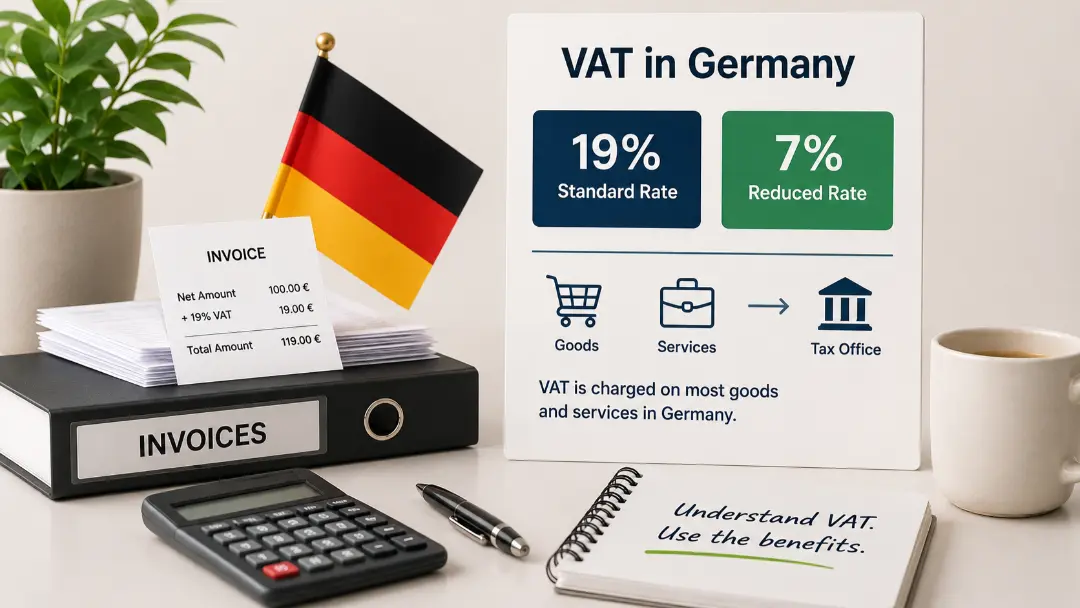
VAT is levied at different rates depending on the type of goods or services, for example newspapers, certain foods, books, and cultural events. The standard rate is 19%, and the reduced rate is 7%. Businesses in Germany are legally required to collect VAT on sales and remit it to the tax office. However, if you’ve made a business-related purchase and VAT was charged on it, you can reclaim it.
Using a VAT Calculator for Germany to Ensure Accuracy
Using the VAT Calculator for Germany guarantees accurate, instant results. It’s particularly useful for converting between gross and net amounts or calculating different tax rates. The calculator not only saves you time but also reduces the risk of issues with tax authorities due to accidental errors.
Why Does VAT Matter?
In Germany, VAT is the government’s most important source of revenue. Its revenue funds public services, infrastructure, and various social programs. Its significance depends on who’s paying it. For the state, it’s a means of improving public welfare. Businesses avoid fines and penalties by calculating VAT correctly. And ultimately, it directly affects the prices consumers pay for goods and services.
How VAT Works, Step by Step
Below, we explain how VAT works in different scenarios.
Factors That Affect VAT in Germany
Even though VAT is charged at a fixed rate, several factors can influence the amount of VAT payable. With our VAT Calculator for Germany, you can configure the various factors that affect VAT in Germany.
Type of Goods or Services
The Standard VAT Rate
The standard VAT rate is 19% and applies to goods and services such as vehicles, electronics, clothing, and freelance services.
The Reduced VAT Rate
The reduced VAT rate is 7% and applies to everyday essentials. It also applies to certain social and cultural services, including basic foodstuffs and public transport tickets.
The Zero Rate
Since 2023, a zero rate of 0% has applied to the supply and installation of photovoltaic systems on or near private residences. In 2026, the capacity limit for this tax exemption was raised from 15 kWp to 30 kWp (peak) per residential or commercial unit.
Business Location
For businesses based in Germany, standard VAT rates apply to domestic transactions. For transactions outside Germany but within the EU, VAT rules and rates differ depending on whether the customer is a consumer or a business.
Customer Type
The type of customer determines the amount of VAT that may apply.
Business-to-Business (B2B)
Under certain circumstances, a business purchasing goods and services from a VAT-registered business within the European Union can use the reverse-charge mechanism. Under this mechanism, the purchasing business must account for VAT in its own country.
Business-to-Consumer (B2C)
When the purchase is made by a private consumer rather than a business, VAT is generally charged at the seller’s local rate.
Import and Export Transactions
Special VAT Rules
If a small business (Kleinunternehmer) generated no more than €25,000 in revenue in the previous year and is expected to generate no more than €100,000 in the current year, the small business regulation applies. In this case, no VAT is shown on invoices, but in return, no input tax deduction is possible either.
The Role of a VAT Calculator in Germany
The VAT Calculator for Germany is an indispensable tool that lets consumers and businesses determine their VAT liability instantly and accurately. Simply enter the net value of the product or service and select the applicable VAT type (standard or reduced rate). The VAT Calculator immediately shows you the amount payable or receivable.
Calculating VAT – Practical Examples
Below are some practical examples illustrating how the different VAT rates apply to goods or services.
Example 1: Standard VAT Rate (19%) – From the Net Price
A laptop is sold for €1,000 net.
Example 2: Reduced VAT Rate (7%) – From the Net Price
A set of books costs €200 net.
Example 3: Deducting VAT from the Gross Price (19%)
A car is sold for €23,800 gross.
Example 4: Calculating Import VAT
If a business imports goods with a net value of €5,000 from outside the EU, with shipping costs of €200, the tax base is €5,200.
VAT Compliance and Reporting Obligations in Germany
Depending on the tax office’s requirements and the business’s revenue, businesses must file their VAT returns monthly, quarterly, or annually. The VAT return includes:
Penalties for Incorrect VAT Calculation
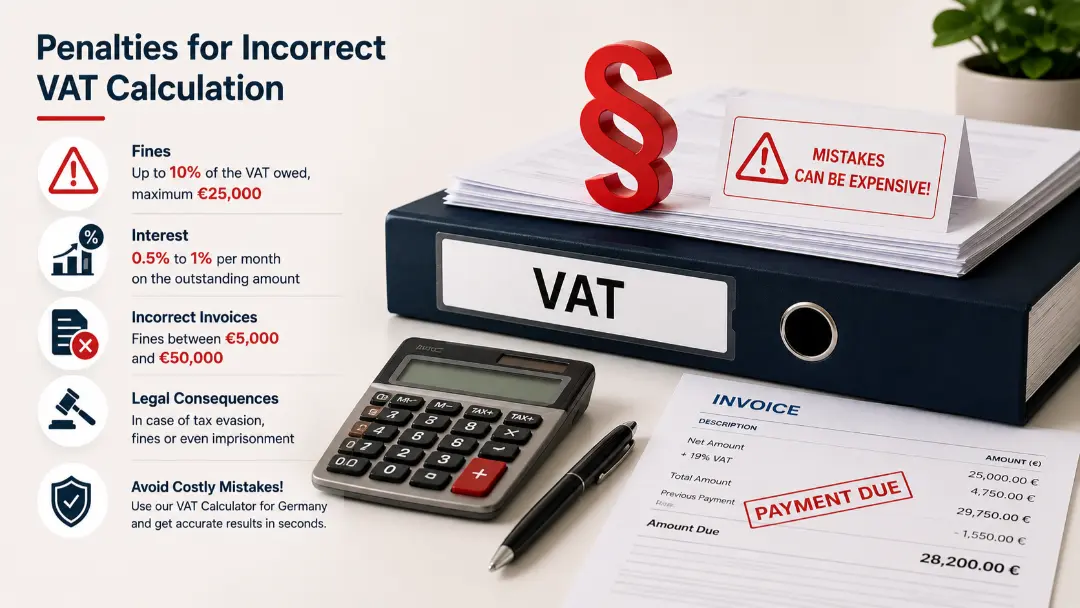
Anyone in Germany who pays VAT incorrectly or fails to pay it at all faces various fines and penalties. A fine of up to 10% of the VAT owed can be imposed, up to a maximum of €25,000. Additionally, monthly interest of 0.5 to 1% accrues on the outstanding amount.
Issuing incorrect invoices or making repeated negligent errors can result in fines between €5,000 and €50,000. In the worst case, you may face criminal consequences, including imprisonment, if it’s proven that you deliberately underreported your VAT. To avoid penalties for incorrect VAT calculations, use our VAT Calculator for Germany. It provides instant, precise VAT estimates.
The Impact of VAT on Pricing Strategy
Whether to include VAT in the displayed final price or show it separately is a question that concerns many businesses across various industries. Generally, in the consumer goods sector, VAT is included in the total price. In the B2B sector, however, VAT is usually shown separately, and net prices are displayed so the purchasing business can reclaim the VAT.
Possible Future Changes to VAT in Germany
2026 Update: Permanent 7% for Restaurants
Since January 1, 2026, the reduced VAT rate of 7% has applied permanently to all food in the restaurant and catering sector, regardless of whether it’s consumed on-site, taken away, or delivered. Beverages are excluded from this rule and remain subject to the standard rate of 19%. A VAT Calculator makes it quick and easy to calculate the VAT due on food and beverages.
Conclusion
Whether you’re a business owner looking to ensure compliance with VAT law or a consumer wanting to track your purchases transparently: our VAT Calculator for Germany helps you understand VAT and make more informed financial decisions. It calculates gross, net, and VAT amounts clearly for you.