A Complete Guide on How to use Germany Corporate Tax Calculator
Company Profit
Adjustments & Losses
Location & Options
This calculator provides an estimate based on common rules (15% corp tax, 5.5% Soli, trade tax: 3.5% × Hebesatz). Adjustments like interest limitation, non-deductible items, depreciation add-backs, and loss carryforwards/carrybacks are included as user inputs. Not official tax advice.
In Germany every investor, tax manager or company owner needs to have a proper understanding of what is corporate tax, how it affects various businesses and it can be calculated.
The following article aims to elaborate every factor that has an impact on a company’s tax bill and how Germany corporate tax calculator can be used for the whole calculation.
Factors such as the solidarity surcharge, trade tax (Gewerbesteuer), loss carryforwards and carrybacks are discussed at length. The Germany corporate tax calculator also keeps up with the recent revenue trends of the German corporate taxation system.
The goal is to understand how you can attain your desired results by giving the Germany corporate tax calculator proper input of the various factors that impact the corporate tax.
The Germany Corporate Tax Calculator Explained
The Germany corporate tax calculator is a calculator that takes the company’s taxable profit and applies the solidarity surcharge, the statutory corporate income tax, local trade tax or any other credits and converts it into after-tax profit.
The corporate tax burden in Germany is composed of three major factors:

Due to the locally set multiplier known as (Hebesatz), the municipal trade tax varies from one location to another.
The combination of these factors helps us determine the average tax rate of a corporation.
The Statutory Corporate Income Tax
A company in Germany is charged 15% statutory corporate income tax on their taxable profits. It does not matter where the businesses are stationed at, as long as they are within the Germany the same percentage of income tax will be applied across all federal states.
On the basis of adjustments made due to non-deductible expenses, certain statutory provisions and depreciation rules the taxable profit which is calculated according to specific German tax accounting rules might differ from the financial statement profits.
This 15% percent is the core tax that is applied to a corporation’s earnings and is also the first figure that the Germany corporate tax calculator will consider while calculating taxes.
What is Trade Tax?
Trade tax is that one factor in this entire calculation that varies the most based on location. The trade tax base begins when certain deductions and add-backs are adjusted from the taxable profit. The statutory base rate is 3.5%.
When calculating the trade tax, the most variable factor is the municipality’s Hebesatz also known as (multiplier) and it is expressed in percentages for instance (300%). The municipality decides how much they want the Hebesatz to be, so it varies from one municipality to another. Often times it is observed that the bigger cities tend to have a higher Hebesatz rate as compared to the small cities.
The trade tax is therefore calculated by multiplying the base rate with the multiplier 3.5% × (Hebesatz / 100). In order to compute the trade tax effectively our Germany corporate tax calculator allows you to input the percentage of your Hebesatz.
Combined Statutory Rates
In order to attain the combined corporate tax burden of German companies, all you need to do is take the 15% federal income tax rate and add the calculated solidarity surcharge in it making it approximately (~15.825%) and lastly add the varying trade tax.
On the basis of local tax multiplier varying on the basis of location, the statuary tax burden for most of the places is somewhere between 29% to 31%. Our Germany corporate tax calculator displays the calculations of both individual factors as they are and also their total statuary rate.
What are some of the factors that impact the Corporate Tax Rate
Following are the various factors that have an impact on the final corporate tax in Germany. the Germany corporate tax calculator adjusts these factors and provides you with accurate results.
Non-Deductible Expenses
For tax purpose, there are some certain expenses that cannot be deduced such as portions of representation costs, entertainment expenses and penalties/fines
Add-Backs
It is required by some tax rules that the depreciation difference be added back. This can interest limitations or include non-arm’s-length payments
Depreciation and Amortization Rules
Tax depreciation methods and useful lives may differ from accounting depreciation, changing taxable profit.
Interest limitation Rules
Interest limitation and thin-capitalization rules can be applied by Germany in order to restrict interest expense deductions
Loss Carryforwards and Carrybacks
The present value of deferred tax assets and current tax bills is affected by tax loss rules.
Rules for Affiliated Companies and Group Taxation
Tax outcomes can be changed due to tax consolidation rules which allows profit and loss pooling under certain circumstance.
The impact of Losses, Carryforwards, and Carrybacks on Tax Payable
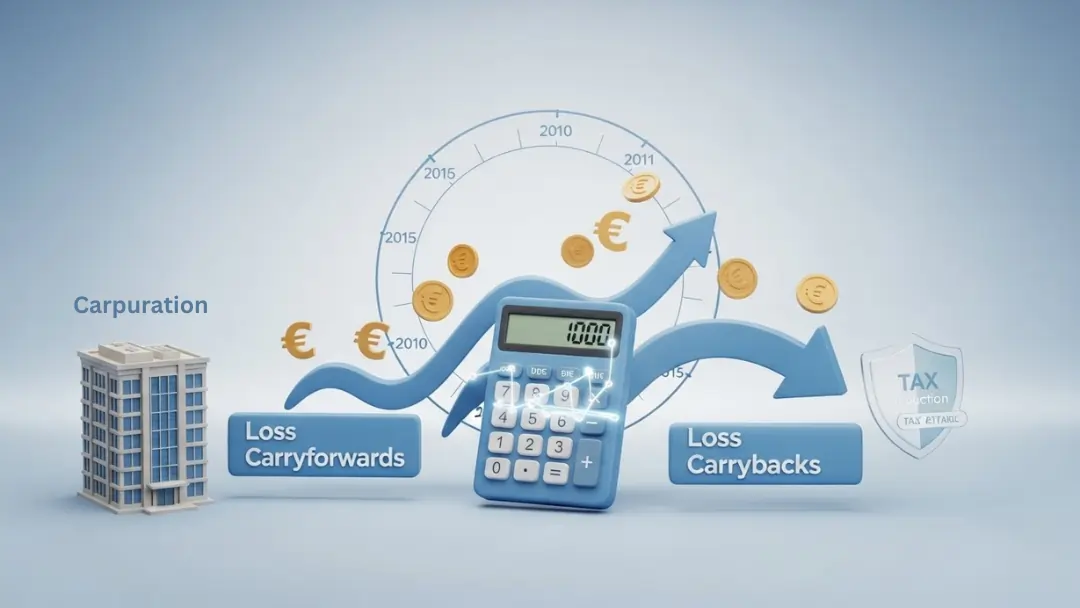
Extended carryforwards and limited loss carrybacks are allowed by Germany under certain rules and condition. The current tax payable can be lowered by past losses if they exist. Our Germany corporate tax calculator lets you know if the group relief rules apply to your corporation or not by allowing you options to input available loss carryforwards and carrybacks.
Recent Policy Developments and Future Rates
Over time due to new tax rules and latest political initiatives the effective rate can change. Methods to incentivize investment and gradually lowering the federal corporate rate have been discussed in recent government proposals and policy discussions.
Best Practices for using a Germany Corporate Tax Calculator
Conclusion
A good functional calculator like Germany corporate tax calculator does more than just multiply profit with a single rate. It makes taxable-base adjustments and provides accurate depiction of what a firm’s tax bill will look like by factoring in 15% model federal corporate tax, 5.5% of the solidarity surcharge and the municipal trade tax (3.5% base × Hebesatz). It also provides fields to input data such as interest limitation effects, loss carryforwards, depreciation differences and non-deductible expenses. When used correctly it proves to be a indispensable tool for calculating corporate tax in Germany.